Trending »

Read More »
  • The Summer I Was 14 – Penny Perry

    on February 22 | in Poetry | by | with No Comments

    I smell her cigarette-coffee breath,
    my mother’s face is so close to mine.
    She slaps Gentian Violet
    on the rash and welts in the swollen folds
    of my vagina, erupting with angry splotches.
    I’ve never seen my mother so angry.
    Violet stains her fingers.
    Her cheeks are red. The Gentian brush
    has little bristles that wound my
    already sore skin.

    “It stings,” I cry. Legs open,
    I sit on the toilet seat.
    My sucked in breath sings through
    my teeth. I don’t know the cause
    of the rash making my vagina sore,
    think it’s just another new plague,
    like my wheeze from asthma
    that she says sounds like the Mormon Tabernacle Choir,
    my constantly running nose, hives
    that appear for no reason
    except that I’m allergic to poison oak,
    ivy, sumac, and 36 native grasses.

    Before I remember, she
    changed my diapers. Now
    a high school freshman,
    I haven’t even been nude
    in front of my formal mother
    in years.

    “You did this to yourself.”
    Her voice is a hiss.
    My mother, who makes cauldrons
    of chicken soup when I have the smallest sniffle,
    dips the spiky Gentian Violet brush,
    re-loading.

    Years later, I will learn
    that when she was 13, she had a 21 year old lover.
    My new boyfriend is 14 like me. Chaste,
    we only hold hands when we ice skate.
    Usually so quick to blame myself, I look

    at her blotched face, shaking hand.
    I’ve done nothing wrong.
    “Stop,” I tell her.

    She has gone crazy, gone loco
    like men or dogs who chew
    the poisonous white Jimson weed.
    “It hurts.” My cheeks are wet.
    She dips the brush again.
    My mother is treating my vagina like some
    old chair she no longer cares for,
    but is willing to repair with a spatter
    of color. The hot August wind
    blows in from the bathroom window.


    Penny Perry been nominated for a Pushcart Prize six times, by six different publishers. Garden Oak Press has published two of her poetry books, Santa Monica Disposal and Salvage and Woman with Newspaper Shoes. Her poetry has appeared in many publications, including Lilith, Poetry International, San Diego Poetry Annual, Paterson Literary Review, and Limestone Circle. Her  novel Selling Pencils and Charlie was a finalist in the San Diego Book Awards. She was the prose editor at Knot Literary Magazine for ten years. In the early 1970’s, she was one of the first female screenwriting fellows at the American Film Institute; a screenplay she wrote there became a film on PBS.

    Read More »
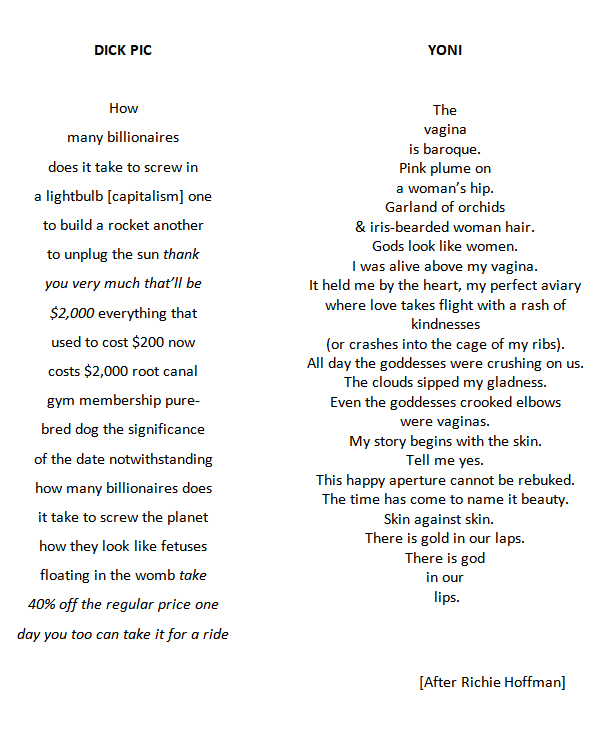
  • Dick Pic [Elizabeth Knapp] & Yoni [Pamela Hughes]

    on February 22 | in Poetry | by | with No Comments

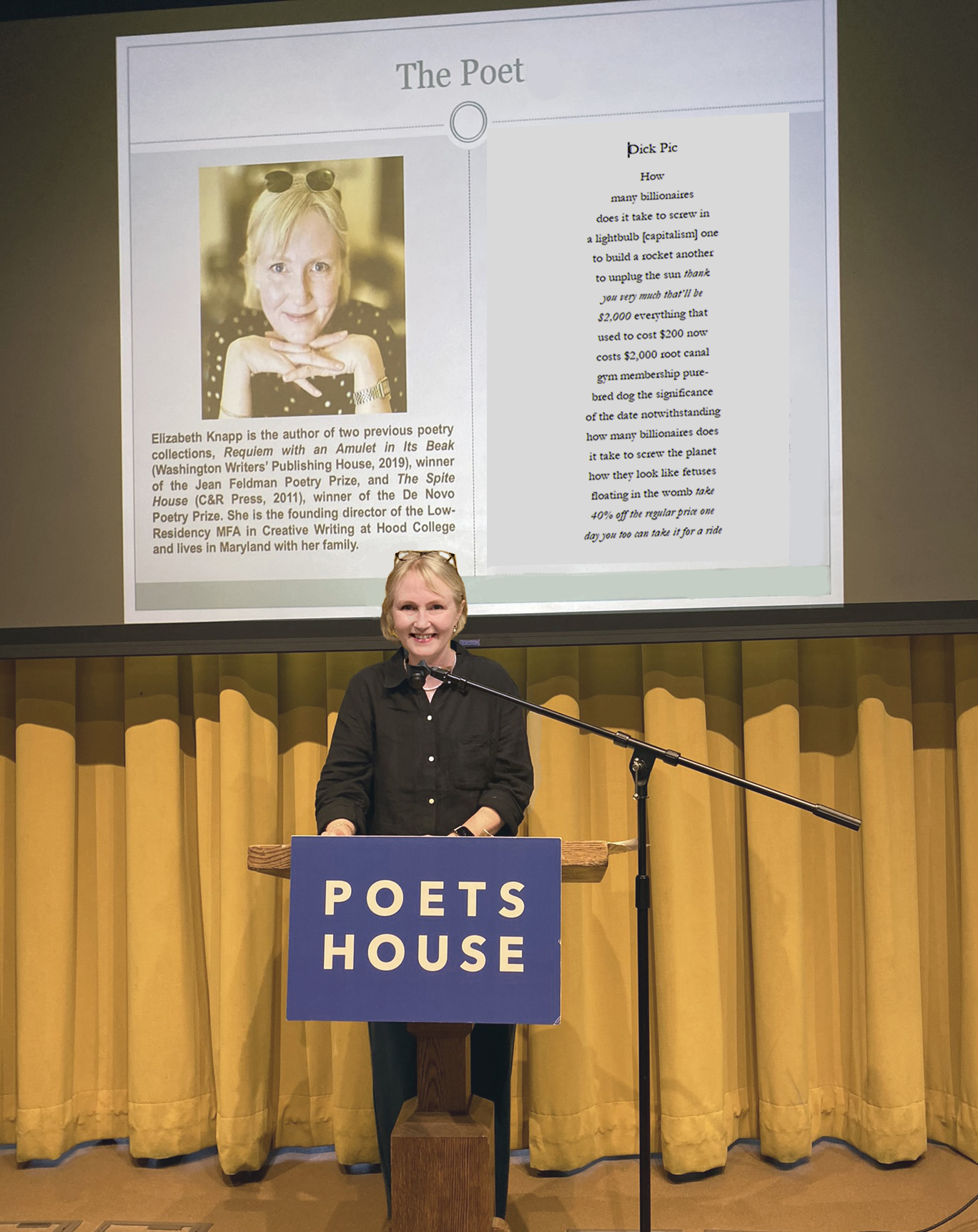
    Elizabeth Knapp (she/her) is the author of three poetry collections, Causa Sui (Three Mile Harbor Press, 2025), winner of the Three Mile Harbor Book Award; Requiem with an Amulet in Its Beak (Washington Writers’ Publishing House, 2019), winner of the Jean Feldman Poetry Prize; and The Spite House (C&R Press, 2011), winner of the De Novo Poetry Prize.

    Other awards include the 2018 Robert H. Winner Prize from the Poetry Society of America, the 2015 Literal Latté Poetry Award, the 2007 Discovered Voices Award from Iron Horse Literary Review, and a Maryland State Arts Council Fellowship. She has published poems in The Kenyon ReviewThe Massachusetts ReviewNorth American Review, and Quarterly West, among others. 

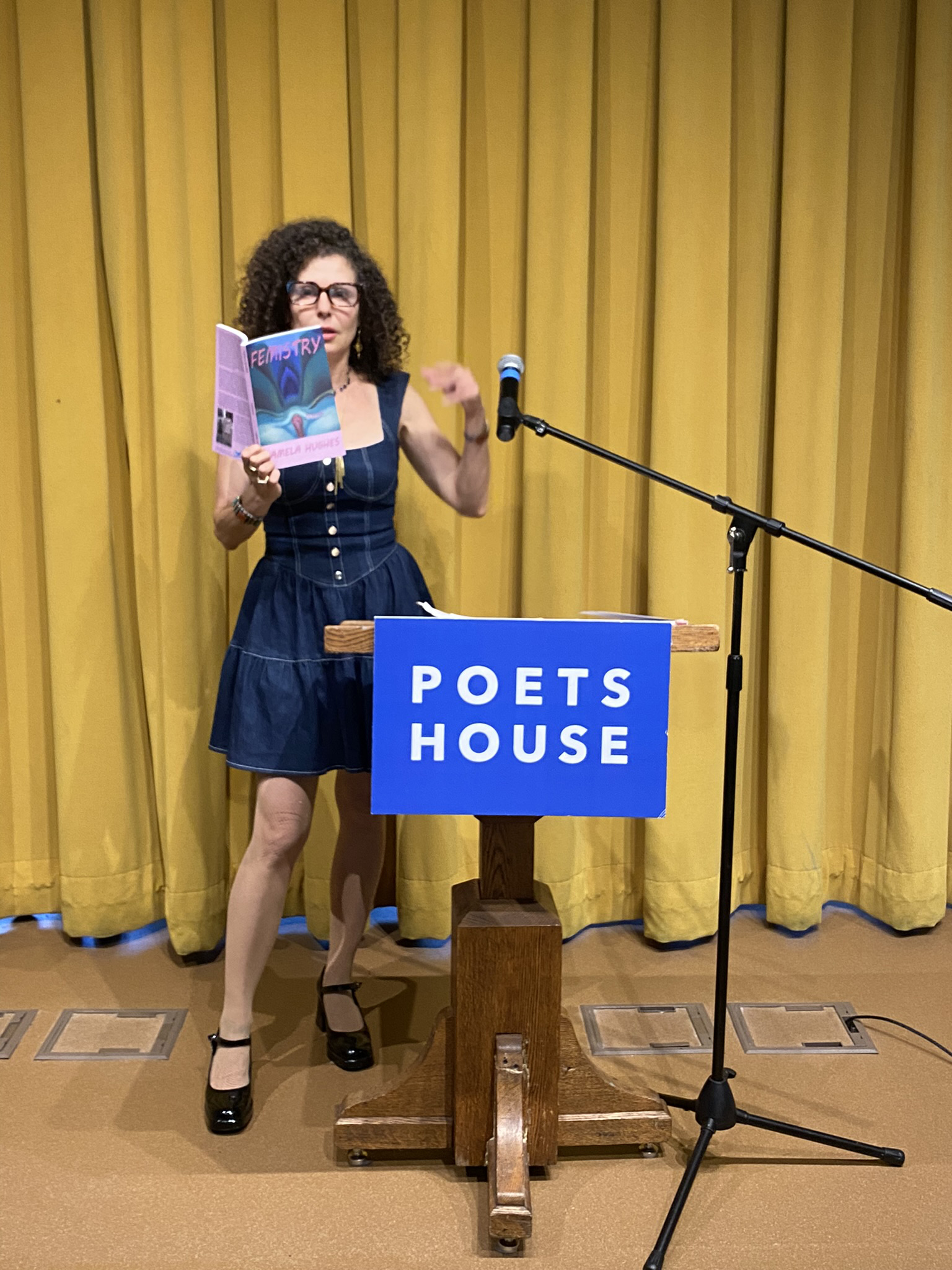
    Pamela Hughes is the editor of Narrative Northeast. See the masthead for more info.  During their dual book launch, Elizabeth and Pamela read from their collections at Poets House in New York. 

    Read More »
  • Image: ON BEAUTY – Vida Kazemi

    February 20 | Poetry | | 0

  • Ode to the Vast Space of Sand We Called a Football Field – Isra Abdalla

    on February 19 | in Poetry | by | with No Comments

    & i don’t know how to tell you about
    how emptiness can be holy if you never look down–
    boys building a universe out of a deflated football
    boys that would be kings that would be gods
    boys that would be pulled out of their
    mother’s bodies that would be pulled
    out of rubble & what is rubble if you wear a crown
    for long enough?

    & i don’t know how to tell you about
    when no one knew the ringing of a gun–
    boys who never know how the bullet lodges itself
    into their ribs like it’s trying to make a home in the malaise
    between life and extinction. i hope that nobody has to know
    what it is to be betrayed by a city that extorts blood
    to gold. that nobody has to be left behind by a city
    promising itself into a homeland

    & i don’t know how to tell you about
    the irony of sudan being on fertile land–
    boys that will be brothers that will be fertilizer
    boys grasping at the holy cradle of a lying mother
    boys knowing that the swell of a womb is always spectral
    & you run so fast that you fly you run so fast
    you barely notice matriarchal teeth sinking into boy’s skin

    & i need to tell you about how
    you run so fast you barely notice the tender tongue of
    rebirth licking its way into boy’s bodies until they
    meld into each other & you can’t tell them apart past
    blood on black bodies & blood on black bodies
    & i can only ask you to see
    the light & see the light & see

    Isra Abdalla (she/her) is a second-year student pursuing an undergraduate degree in English Language and Literature. She is a Sudanese writer and a certified theatre kid (with a minor in theatre). Her work has been published in Partially Shy Magazine, Catheartic Magazine, Healthline Zine, and her university’s literary journal. More of her work can be found on fruitjam.substack.com

    Read More »
  • how we left – Winter Yim

    on February 18 | in Poetry | by | with No Comments

     i slink from bed
    & i drag my limbs
    past your grey New Balances
    & your slight cache
    of a stomach,
    your black inked star &
    crescent, sternum
    stretched & anxious
    thoughts tear rings
    off Saturn & i want
    to  slow     down. so
    my footsteps don’t screech
    the northern sun
    exposed floorboards
    & inside, i weep
    glass shards, my guts
    churn butter & my legs
    retreat into
    the clanking of paper
    ice skating the table
    & i’ve seen you
    so far   & i start
    to write   & you
    sleep in. your breaths
    are the moments	
    before a tea
    kettle whistle
    & already
    are you thinking
    how to find a way out?

    Winter Yim (they/them) is an emerging writer originally from Massachusetts and currently based in New Jersey. Their writing covers themes such as home and belonging, identity, and queerness.

    Read More »
  • BORDER CROSSING – Tom Csanadi

    on February 18 | in Creative Nonfiction & Memoir | by | with No Comments

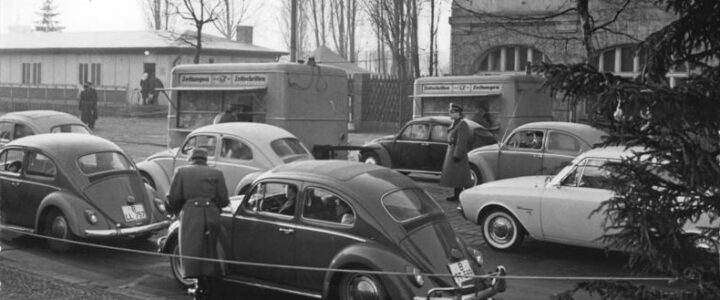
    I could tell we were getting close to the border because my dad was nervous. He tended to get very nervous anyway and when he did, he became testy. Well, he got mean. As he drove, he seamlessly moved from bickering with my mom, to cutting her off when she tried to calm and redirect him, to spouting an occasional spicy Hungarian idiom, to shouting that it was all her fault and threatening my two older brothers and sister and me in the back with his almighty hand, to punching the dashboard and erupting in odd snorting noises that, in another setting, might have been pretty funny. But this evening we fell into our usual terrified place. He undeniably had his demons and he was entirely generous in wanting them to meet us, too.

    It was 1968 and I was eight, already a veteran of European travel, this being my third trip. We were in our faithful VW in Austria and closing in on the border to Hungary. On our first trip three years earlier, we took the very same road to the same border crossing and felt the same fear. To this day, nearly six decades later, I still hold a razor-sharp memory of my dad, wide-eyed and pacing just outside our car, noticeably sweating.

    We now saw the familiar barbed wire fencing and concrete guard towers: soldiers in oversized, forest-green uniforms wore military caps the size of our biggest serving plate, their rifles slung like sinister sashes across their chests. A border crossing through the Iron Curtain was an edgy, drawn-out ordeal those days. We became suspects and were told to wait inside a colorless, tasteless and unfriendly building – everything traditional Hungary was not – while they processed our visas and searched our car and luggage for contraband. My mom always did somehow manage to sneak in a pair of blue jeans, though. I also quickly learned that it never hurt to pass on a bottle of wine from the West to grease the bureaucratic gears.

    Originally, my parents, along with my older brother and sister, were born into Hungarian citizenship, but fled the country in 1956. They found their way to the U.S. and in 1963, on the very day Kennedy was assassinated, raised their right hands and swore their loyalty to the United States of America. Forever homesick, my gentle, yet bull-headed mom corralled her four young kids and one reluctant and insecure husband to travel from Southern California to the home country every one to two years now that they all wore the protective shield of the blue U.S. passport. My dad was never convinced the shield would hold.

    Twelve years earlier, in 1956, Vice President Richard Nixon was on a diplomatic mission to visit refugee camps in Austria that housed Hungarians who fled the brutality of the Soviet crackdown after everyday citizens staged a brief revolution that shook the Communist world. The Time magazine Person of the Year became the Hungarian Freedom Fighter, collectively those who made outlandish demands for things such as a free press, free elections and a representative government. Nixon was going to up the quota of refugees the U.S. would accept, referring to them as “young, the leadership type.” In 1956 my mom and dad and, at that time, their two young children met that requirement. In fact, they struck such a photogenic family portrait in that refugee camp that their immigration to the U.S. was expedited.

    Now, by the time we ducked through the Iron Curtain and finally did get into Hungary, darkness had descended, so for the rest of the drive angling shadows cast by dim lights skittered past us with suspicion.

    Pulling into the parking lot below my uncle’s high-rise, the emblematically ugly Communist-era concrete block of an apartment building, always felt magical, even if that magic leaned a tad dark. We soon succumbed to wails of grieving joy and the kind of Old-World kisses that sucked up a child’s entire cheek. I remember that my uncle was already downstairs from his 9th floor apartment to meet us, and this time when he did, he held up a newspaper. I could see the name “Nixon” in bold print and then heard him say that Nixon had just won the election, and I can still taste my eight-year-old version of the clash of two very different worlds.

    *

    v
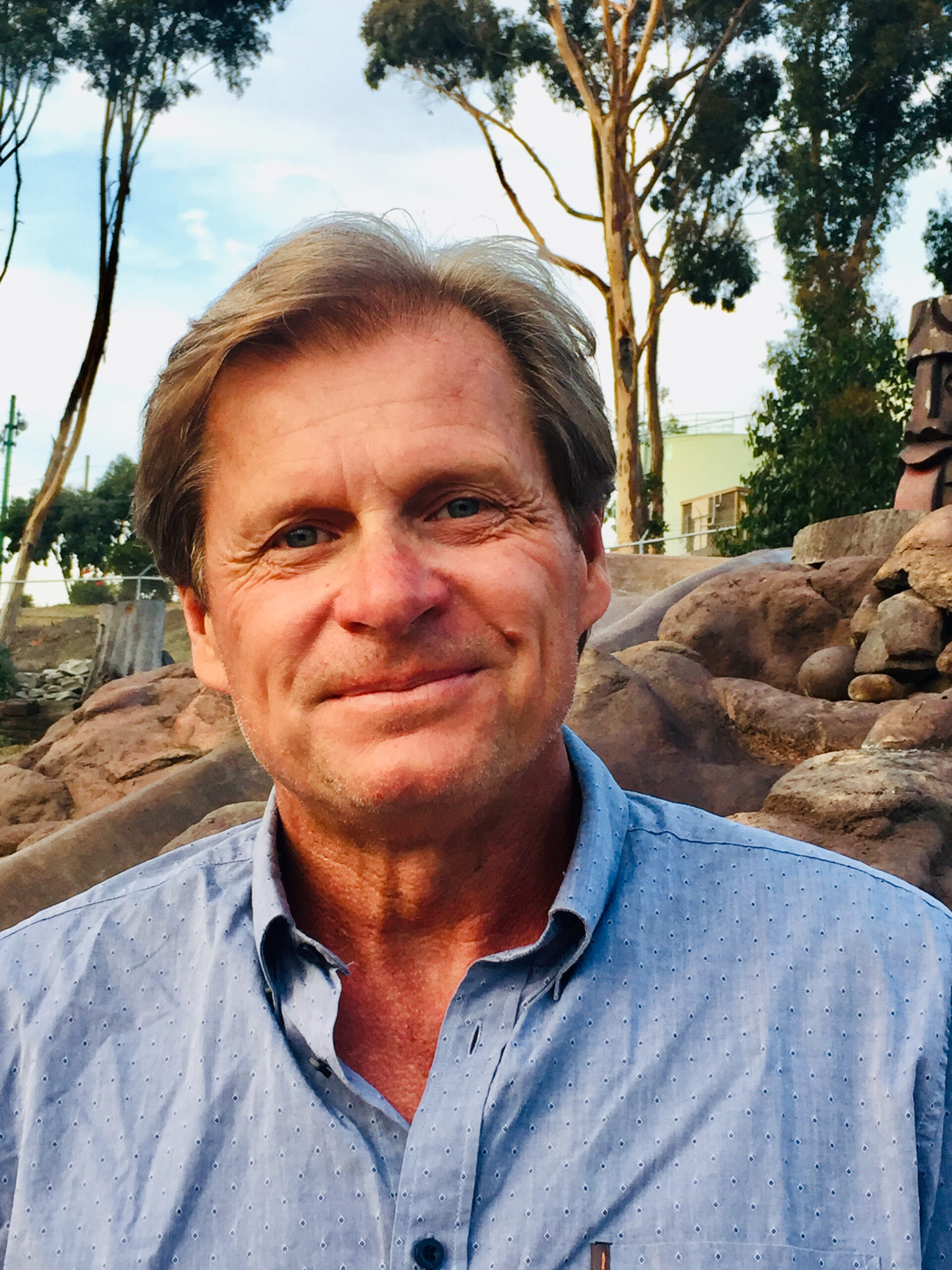
    Tom Csanadi is retired pediatrician and is currently enrolled the Creative Writing certificate program through UC San Diego. As a first generation American of Hungarian refugee parents who fled their home country during the 1956 Revolution, he is passionate about drawing attention to the struggles faced by diverse groups of people. His view has also been honed from bearing witness to the full spectrum of the human condition during my career working with immigrant communities

    Read More »
  • MONKSHOOD – Charles Brice

    on February 18 | in Poetry | by | with No Comments

    I wish everything in my life

       could be as simple

           as the orange leaves

               on our service berry bush

    *

    or the purple plumes

       of our monkshood plants.

           But we can’t get in touch

                with our friend, Lily.

    *

    She lives in two rooms

        with her husband and three

            children. They went through

                everything awful to get

    *

    to our country where they started

        their new lives in the land

            of freedom. The lawyer told

                 them their papers would

    *

    be ready last month. They don’t

        know what the hold-up is.

            Today men in masks put

                 them in a truck

    *

    with no license plates. We can’t find

        them. We don’t know where

            they are. For them our country

                has become like our


    *monkshood—every part

        of that plant is deadly,

         poisonous, but

            beautiful to look at.

    Charlie Brice won the 2020 Field Guide Poetry Magazine Poetry Contest and placed third in the 2021 Allen Ginsberg Poetry Prize. His tenth poetry collection is A Brief History of the Sixties (Alien Buddha Press, 2026). His poetry has been nominated for the Best of Net Anthology and the Pushcart Prize and has appeared in Atlanta Review, The Honest Ulsterman, Ibbetson Street, Chiron Review, The MacGuffin, and elsewhere.

    Read More »
  • The PALIMPSEST – Gunilla Theander Kester

    on February 15 | in Poetry | by | with No Comments

    My mother tongue is a deceptive septic tank.
    It stinks but also smells at times of honeysuckle.
    Fills treachery with a sudden flight of angels
    9
    It curses and cries and breaks down on the road
    like my grandpa’s old green Mercedes. Drops of gas
    filters through it like raindrops leaving oil and mud.
     
    A mess to clean or bury it has footprints on the side
    showing everyone where to cross and how to count
    the structure of colors and cracks in every distant corner
     
    the hopes, the drains, the longing of stranded balconies.
    And under it, the one climbing rocks for the view
    who likes making other people use its power tools.
     
    Below, below, the enemy language where the Dativ
    whips the Akkusativ, their identities live to confuse
    foreigners and students, live for orders and graves.
     
    Letters parched and dry, pressed between the pages
    of old books and envelopes, lists stuck in dusty drawers
    left under an old flower pot. Debts unpaid.
     
    9
     
    Swedish-born Gunilla Theander Kester is an award-winning poet and the author of If I Were More Like Myself (The Writer’s Den, 2015). Her two poetry chapbooks: Mysteries I-XXIII (2011) and Time of Sand and Teeth (2009) were published by Finishing Line Press. She was co-editor with Gary Earl Ross of The Still Empty Chair: More Writings Inspired by Flight 3407 (2011) and The Empty Chair: Love and Loss in the Wake of Flight 3407 (2010). Dr. Kester has published many poems in Swedish anthologies and magazines, including Bonniers Litterära Magasin. Her work has or will be published in On the Seawall, Cider Press, The American Journal of Poetry, Pendemics, and Atlanta Review. She lives near Buffalo, NY where she teaches classical guitar.

    Read More »
  • WORDS – Claire Scott

    on February 13 | in Poetry | by | with No Comments

    Some Yogis in ancient India believed
    every person comes to this earth
    with a fixed number of breaths
    allotted by the Almighty. Once we exhale
    our last breath, we leave this life, whether we are six
    or forty-six or ninety-seven.

    What if we each arrived
    with a finite number of words,
    say nine hundred million
    which sounds like forever
    but we spend about seven thousand a day
    mostly drivel and dravel
    and when we speak our final word,
    the one at the very bottom of the basket
    “fly” or “freeway” or “fuck”
    we would promptly pass away.

    What if we kept words safe in a tattered purse or
    tucked in winter boots in the back of a closet.
    What if we savored words, spent them
    wisely, not wasting them arguing over
    who last took out the trash
    or how many angels can dance
    on the back of a bitcoin.
    But for sure take out a few for freshly
    baked bread or a pot of pink begonias,
    when a simple smile won’t do.
    Spend two soft words: thank you
    and notice how your step is lighter.

    %

    Claire Scott is an award-winning poet who has received multiple Pushcart Prize nominations. Her work has appeared in the Atlanta Review, Bellevue Literary Review, New Ohio Review and Healing Muse among others. Claire is the author of Waiting to be Called and Until I Couldn’t. She is the co-author of Unfolding in Light: A Sisters’ Journey in Photography and Poetry.

    Read More »
  • BODIES AT SEA

    on February 11 | in Poetry | by | with No Comments

    I want us Kodaks in the salt spray
    off Cape Cod’s hook. With them, of course.

    Lungs crackling, bones worm-holed.
    Two pipers dance on driftwood,

    their skeletons to be polished wood or stone.
    Such feeble whirligigs, spun by a fractious wind.

    I want us cosseted below deck,
    captained in hammocks and dreams.

    The hounds translate to dogfish, no more smog-
    colored irises, beseeching paws.

    Our ship trawls the Eastern coast,
    Verne’s giant squid feeding, a monstrous hypothetical.

    We could call it Death.
    What’s invisibly certain and with that, not particular.

    There’s a book of indestructible matter
    in which we are all named,

    snail feet embedded in sand,
    negatives curling up on some implacable bonfire.

    Tossing our chained hearts overboard to the jet-black sea,
    our very monsters are tangled in a starry net.

    Carol Alexander is co-editor of the award-winning anthology Stronger Than Fear: Poems of Empowerment, Compassion, and Social Justice. She is the author of the poetry collections Blue Vivarium, Fever and Bone, Environments, and Habitat Lost. Her poems appear in About Place Journal, Asheville Poetry Review, Burningword Literary Journal, The Common, Cumberland River Review, Denver Quarterly, Free State Review, Mudlark, Narrative Northeast, New World Writing Quarterly, One, RHINO Poetry, Southern Humanities Review, Third Wednesday, Verdad, Verse Daily, and other admired print and online journals.

    Read More »
  • POETRY IN CATCHMENT – Michele Worthington

    on February 8 | in Poetry | by | with No Comments

    A word calls my name
    others answer in rhyme from the canopy
    where greenery is fluent and lemurs
    with cursive tails leap
     
    zigzagging in chatter
    across shadowed valleys
    of linguistic tributaries
    from this babble
    vowels fall and almost drown
    mouth deep
     
    I backtrack the primates
    upstream follow
    the verses they left
    in whorls in the water
    created out of
    held breath
    and wooden paddles
    with temporary fingers
     
    I scoop one up
    it keeps its bowl form
    and whirling movement
    in my cupped hands
    a blur of turning water
    slowing,
     
    letters precipitate
    with sediment from a dreamt
    existence
    peripheral
    to this vessel
     
    8
    Michele Worthington lives in Tucson, AZ where the Sonoran Desert, urban sprawl and our unacknowledged apocalypse inspires her writing. She has had poems published in Sandscript, Sandcutter, and Sabino Poets; an online chapbook at unlostJournal.com; and photography and poetry in Harpy Hybrid Review. She was a Tucson Haiku Hike and Arizona Matsuri contest winner, and a finalist for the 2023 Tucson Festival of Books literary awards.

    Read More »
  • FROM – Shontay Luna

    on February 2 | in Poetry | by | with No Comments

    I’m from incense, from Calgon and
    cassette tapes. I am from the window
    of my teenage bedroom; screenless
    thirteen floors above ground, full of
    mystery, night and glittering lights.
    I am from crabgrass in the concrete.
    Breaking free; the jagged edges
    contrasting against the cracks. I’m
    from playing Spades while sending
    the kids to sleep so the adults could
    party. From Cousin Billy and Great
    Grandma Flora. I’m from expertly
    hiding pain behind laughter while
    making as few waves as possible.
    From being too quiet and needing to
    defend myself. I’m from church
    services that induced starvation;
    from that toddlin’ town and semi-
    mysterious Cajun lineage. Smothered
    chicken and black eyed peas. And
    from the time I left my little brother
    in the snow while going home from
    school in the blizzard of ‘79.

    8

    *

    Shontay Luna is a poet / fanfiction author whose first job was a Movie Theater Concessionaire. Her poems have appeared in Olney Magazine, [alternate route] and The Literary Nest, among others. The author of four chapbooks, she lives in Chicago with her notebooks, pens and fanfiction fantasies.

    Read More »
  • NIGHT RUNNER – Dennis Cummings

    on January 29 | in Poetry | by | with No Comments


    On sleepless nights
    I circumvent the jack-hammers,
    the asphalt rollers – huge drums
    that press and level hot black gum.

    Dodge the strobes
    that flash atop A-frames,
    run past pop-up sprinklers
    and curtained rectangles of light.
    Inhale diesel fumes
    at the edge of the city
    where bulldozers are starting up.

    Jog this fogless morning
    until a trail is reached
    that ascends the foothill’s summit –
    from where the valley is surveyed
    as if I were an explorer.

    These runs are getting harder
    with my worn-out spine –
    a rusted bicycle chain
    that won’t straighten out.
    A van the color of nopal
    raises dust, cresting the rise,
    and something says they’re not coming
    to bring me water.

    Dennis Cummings lives in Poway, CA. He has lived in San Diego County all his life and has worked with flower growers there for more than four decades. He studied creative writing at San Diego State for a while during the early seventies. His poems appear or are forthcoming in Watershed, Barnstorm, The Baltimore Review, Bicoastal Review and others.

    Read More »
  • CLOUD OF LOCUSTS – Michael Gray

    on January 27 | in Fiction | by | with No Comments

    I was only fifteen when we lost our farm and had to move into town. All the stock and equipment were auctioned off and there was only enough money left to rent a duplex on the edge of town, by the grain elevator, but at least there was a view of a soybean field.
    Our towering farmhouse on a rise overlooking the county was sold to a developer who flattened it. New cookie cutter homes sprang up out there like wildflowers on a prairie. My father called it “a capitalist pestilence.” He said it would sweep the countryside like a cloud of locusts.

    I got a paper route to bring in a few dollars after school. I even delivered eggs on weekends for a farmer we knew. My father rigged a basket on the back of my bike for the egg cartons. It tickled him to do that, to make something with his hands.

    My mother cleaned houses and assisted several elderly ladies. For a while, my mother and I were the only ones working. We were rent ahead a few months, but what the two of us earned barely kept us all fed. My mother urged my father to call in a favor and hire out as a hand to farmers who hadn’t yet sold out, but his stubborn pride wouldn’t allow it. He would shake his head sadly and look away each time she brought it up. He said he could never look a farmer in the eyes again.

    “Then you better avoid mirrors,” she said.

    My father grudgingly filed for unemployment and then swallowed some pride and put on his one good suit and slicked down his hair and interviewed with Contented Cow Dairy delivering milk to houses on what used to be our land. That was a bitter pill for him to swallow but rent was due and there were only a few dollars left in my mother’s cookie jar on the kitchen counter.

    The route manager had a soft spot for farmers who’d gone belly up and so he put my father to work. The milk he delivered might have even come from our cows. The cookie jar was back in business as our little bank, my mother the bank manager.

    Contented Cow Dairy made my father wear a “prissy” white uniform and a white cap with a black visor and a contented cow emblem over the visor. He drove a white panel truck with a smiling cow painted on the truck’s side. He hated the white truck, whose horn made a mooing sound. He hated the smiling, contended cow. He hated the rows of bottled milk rattling against each other as he drove.

    “I know how to milk a fucking cow, for Christ’s sake,” he said one day standing on the Contented Cow loading dock, but the other men just smirked and exchanged glances as they shuffled off to their trucks.

    Mostly, though, my father hated the hat. He said it made him look like an ice cream vendor. He tried wearing it at what was termed a jaunty angle, like a solider might, but the route manager had him pull it back down square on his head. One day, my father wore his faded John Deere cap on his route, and they docked his pay.

    The regional manager told him he could be fired for violating corporate policies. My father had never been fired before, although losing the farm amounted to pretty much the same thing. He called it “The tyranny of capitalism.” He said America needed a good dose of socialism and he congregated with a group of other men, some of them farmers who’d gone belly up, too. They were all men with some degree of “hard luck” who believed socialism could one day sweep the countryside like a cloud of locusts.

    It wasn’t long before my father started drinking.

    He’d never been that much of a drinker, maybe a light beer after dinner and then off to bed early, but after each day of driving “that white monstrosity with that fucking cow,” he’d sit out back of the duplex and drink beers silently, his eyes scanning the horizon beyond the soybean field, until the sun faded and dipped away, and my mother called him in to dinner. My mother would have us all link hands around the table and she would thank Jesus for the food. After the prayer, my father’s head always stayed bowed a little longer. I suspected he was praying for something more than just mashed potatoes, which was a staple for us in those days.

    One day, he watched a green John Deere tractor plowing the field behind the duplex. He told me it could even be one of his tractors sold off at auction. He felt sure of it as he tracked its progress, no doubt judging the quality and dexterity of each pass up and down, how the farmer made his turns, how he kept a tight row on each pass. He believed he knew the farmer and one day the man waved at him but at that distance, I’m sure the farmer had no idea who my father was. Just another townie, he probably supposed, who romanticized farming life.

    My father hung his head and watched the tractor head back up the field. He could probably still feel the vibrations from steering a tractor down a field, the steering wheel quivering in his hands, the whine of the engine – the satisfying feeling of nobody looking over his shoulder. He no doubt remembered being his own man, the only boss, and enjoying how to ply his trade.

    I went back inside to help set the table, but my father watched that tractor until the farmer was done plowing and had gone off down the blacktop road, a rash of red colors on the horizon as night fell, and my father rose, a little unsteady, and chugged his beer and threw the bottle against a tree trunk. But he managed to bungle that, too, and it didn’t even break. It caromed off into the yard and he had to fetch it because he knew my mother wouldn’t tolerate beer bottles littering a yard.

    He picked at his food that night, never said a word at the table, and went to bed early while my mother gave him some room and stayed up late doing some sewing for Mrs. Blanchard.
    It wasn’t long before my father got arrested.
    He’d been out one night with his band of wannabe socialists, and they stopped at Bunny’s Tavern and drank too much whiskey. My father recognized a farmer as the man was leaving and he grabbed the man’s arm as he walked by their table. He just meant to say hello, I’m sure, but the farmer didn’t recognize my old man right off in his Contented Cow uniform and words got tossed around that couldn’t get taken back. My father slugged the man when he called him a drunk townie and the farmer went down hard on a table and broken beer pitchers littered the floor.
    The police came and led my father out to a squad car, but the officer in charge was a young man who’d once bailed hay on our farm in the summers when he was a kid. He recognized my father and took off the cuffs by the car and let him ride in front down to the station. My mother had to go down and bail him out. She was fit to be tied and let everyone know it. The cops all smirked and let her have her say. My father had to pay Bunny’s Tavern for the broken pitchers. He was banned from entering the joint for a year.

    I woke up when they got home and I heard her shouting at him, calling him a damn fool and a drunk, but he never said a word, was meek as a lamb, and even slept on the sofa. He was gone the next morning before first light, before my mother and I even stirred from bed.

    It wasn’t long before my father became careless.

    Headed back to Contented Cow one day after making his deliveries, my father tooled along Dorsett Road, his mind no doubt off in the clouds, probably daydreaming about plowing a field with a powerful John Deer tractor. Had he been alert, he might have turned away enough to lessen the impact, to sort of deflect it some, but a pickup truck that ran the light caught him unaware and square on the driver’s side and the Contented Cow panel truck rolled over through the ditch several times.

    They had to cut through the wreckage with the jaws of life to get my father out. But a lot of that life had already ebbed, and the cops took bets on how long he’d last as the ambulance drove away with lights blazing, the siren wailing. We got the call and rushed down to the hospital, my mother pulling me out of school because she’d been told he was touch and go.

    He made it out of a long surgery, and I napped in the waiting room on a sofa while my mother drank endless cups of vending machine coffee and paced. A doctor finally came out, slipping his surgical cap off and looking grave. He looked like a man who’d tried his best but knew it wasn’t enough. My father would have appreciated that quality in the man. The doctor took my mother aside and she listened, head down, nodding a few times, and then he left looking back once, a sad look on his face, and she came over and hugged me and after a while they let us go into the room.

    My father’s head was bandaged, his face swollen. It barely looked like him. There were tubes sticking into him and a young nurse with a blond ponytail checked his pulse. The machines he was hooked up to made quiet clicking noises. The curtains were drawn, and it was kind of dark in there, sort of a half-light atmosphere. The nurse nodded at my mother and left us alone.

    My mother leaned over my father, and I watched from just behind her, peeking around at him. She spoke to him, her voice so low I could not quite make out the words. I did finally hear his voice, but it was a squeaky whisper. Then my mother reached back and tugged my sleeve and pulled me closer to the bed. She sagged into a chair in a corner, arms crossed over her chest.

    My father raised his good arm slightly and motioned me closer. I leaned in close, terrified, but I knew I had to, and that’s when I saw how badly beaten his face was. One eye was swollen shut. I couldn’t make out what he said at first and I leaned closer.

    “Look out for your Ma,” he said, straining to be heard. “And watch out.”

    “Watch out for what, Dad?”

    He tilted his head my way a little and winced.

    “Watch out for the cloud of locusts,” he said, his voice raspy and even weaker. “They’re a coming, sure as day.”

    I nodded and squeezed his hand. It was very weak, barely perceptible, but he squeezed back.

    My father died the next day.

    My mother was with him and held his hand. She told me later that they made their peace with each other. She said he was a good man who just had hard luck. After the funeral, the regional manager for Contented Cow Dairy came around and gave my mother a large check, to go along with the insurance money because the accident had been the other driver’s fault. Contented Cow even paid for the headstone. The regional manager suggested they have a cow chiseled into the headstone, but my mother put her foot down on that. Instead, she had it say, “Here Rests a Man Who was a Farmer all the Day Long,” which was my father’s favorite saying. That Contented Cow money helped see us through those dark days until she re-married and I’d finished college.

    One day in the fall, when the sun’s strength was waning and I could smell autumn in the air, I took my young son out to see his grandfather’s grave. It had been a while since we’d visited. My son only knew a few photos of his grandfather, the ones we kept on the fireplace mantel. We only displayed photos where he was working on the farm or driving a John Deere tractor. In those photos, my father was always smiling, waving — happy. It was how we chose to remember him, at his best.

    “What was he like?” my son asked me while we stood there, a question he’d asked many times, and for which I always struggled to answer well. My father’s grave was nestled under several oaks, and I could hear a soft breeze stirring leaves above us. Then I felt a chill as the sun ducked behind a cloud. I thought about my son’s question for a moment as I stared at the headstone, at my father’s name chiseled in grey granite.

    “He was unlucky,” I said.

    “Are we unlucky?” my son said.

    I smiled and squeezed his hand.

    “No, not at all, son.”

    But I knew that on any day, it could all bottom out if I didn’t keep a tight grip on things, and that luck had nothing to do with it.

    8

     Evoto

    Michael Gray’s work has appeared in Alligator Juniper, Arkansas Review, I-70 Review, Litro Magazine, Ginosko Literary Journal, Adelaide Literary Magazine, Fiction Week, New Plains Journal. Westchester Review, Flashpoint!, Black River Syllabary, Verdad, Palooka, Hektoen International, Potomac Review, Home Planet News, SORTES, The Zodiac Review, and many more.  He is the author of the novels: The Armageddon Two-Step, winner of a Book Excellence Award (December 2019), Well Deserved, winner of the 2008 Sol Books Prose Series Prize and Not Famous Anymore, which garnered a support grant from the Elizabeth George Foundation in 2009. He co-authored the stage version of his novel Exile on Kalamazoo Street (2013).  His novel The Canary, explores the final days of Amelia Earhart ( 2011). His YA novel, King Biscuit, was released in 2012. He is the winner of the 2005 Alligator Juniper Fiction Prize and 2005 The Writers Place Award for Fiction. He earned a MFA in English in 1996 from Western Michigan University.

    Read More »
  • Recent Posts

    News

    THE SACRED GROVE –  [...]

    [new_royalslider id="17"] Ana Flores is a sculptor and ecologist. Her work is informed by how pla

    Safia Elhilo

    2 Poems

    Michele Robinson\'s Art [...]

    Let Me Straddle Your Mind

    X.J. Kennedy

    The Crusader

    Why did you leave bring m [...]

    Yeah bring our electric shaver back, I bought it we shaved each others back it was important to me

    Kwame Dawes

    Kwame Dawes

    BEFORE YOU – Kwame  [...]

    1 Yes, we were country, lived in shotgun shacks, where the road loses its way to dirt and live

    MENSTRUAL FLOWERS – [...]

    [new_royalslider id="11"] Courtesy of the artist and Mizuma Art Gallery  

    WHAT THE WOMB ISN’T [...]

             "Feminism is a socialist, anti-family, political movement that encourages women to lea

    JUNOT DIAZ

    Junot' Diaz and Edison, NJ

    EDISON, NEW JERSEY – [...]

    The first time we try to deliver the Gold Crown the lights are on in the house but no on

    Rachel Eliza Griffiths [...]

    Elegy & Poem

    The March on Washington:  [...]

    OTHER WORLD: A Conversati [...]

    "We are all the other."

    I OPEN A BOX

    …and find inside a picture, of myself as a child, sitting on a small chair, wearing overalls an

    Naive Paintings

    Raphael Perez

    CIRCLES OF THE MOON & [...]

    To Alex, on turning two Some say the Ring of Brogar is the Circle of the Moon. There is n

    In This Issue

    March on Washington An Interview with Cheryl Evans

    5 POINTZ: GRAFFITI MECCA  [...]

    In a strange twist of what seemed like reverse vandalism, the Graffiti Mecca was painted over.

    In This Issue

    Forest Gander A Translation

    In This Issue

    Quassan Castro, poem Grandson to Grandmother

    URBAN CANVAS: Wynwood Wal [...]

    Wynwood Walls, of Miami has been called "a Museum of the Streets."

    Pulaski Skyway

    Low like the mean dream of Newark the sky must have seemed to its builders. Rickety now, unhingin

    THE SPAN & OTHER POE [...]

    At last, the extremes of his present methods seemed to offer the happiest avenues. The strengthe

    Paul Latorre

    5th Limb Poems

    Joan Larkin

    Poem, Knot

    Gina Loring, Def Poetry [...]

    Poem, Look This Way

    In This Issue

    Xue Du, Poem

    AT THE END OF THE DREAM I [...]

    A woman      in a black kimono      dyed black hair disappeared      behind a black curtai

    Marge Piercy

    Poem: Behind the War On Women

    Naive Paintings

    Raphael Perez

    Marie Miazziotti -Gillam [...]

    Maria Mizzotti-Gillan

    Vicky Dantel

    Short Story

    In This Issue

    Pilar Fraile Amador poem

    Quassan Castro

    Poem

    Lugensky Durosier [...]

    Lady Haiti

    In This Issue

    David Trinidad

    In This Issue

    Landzy Theodore

    In This Issue

    Angelo Nikolopoulos

    Scroll to top